
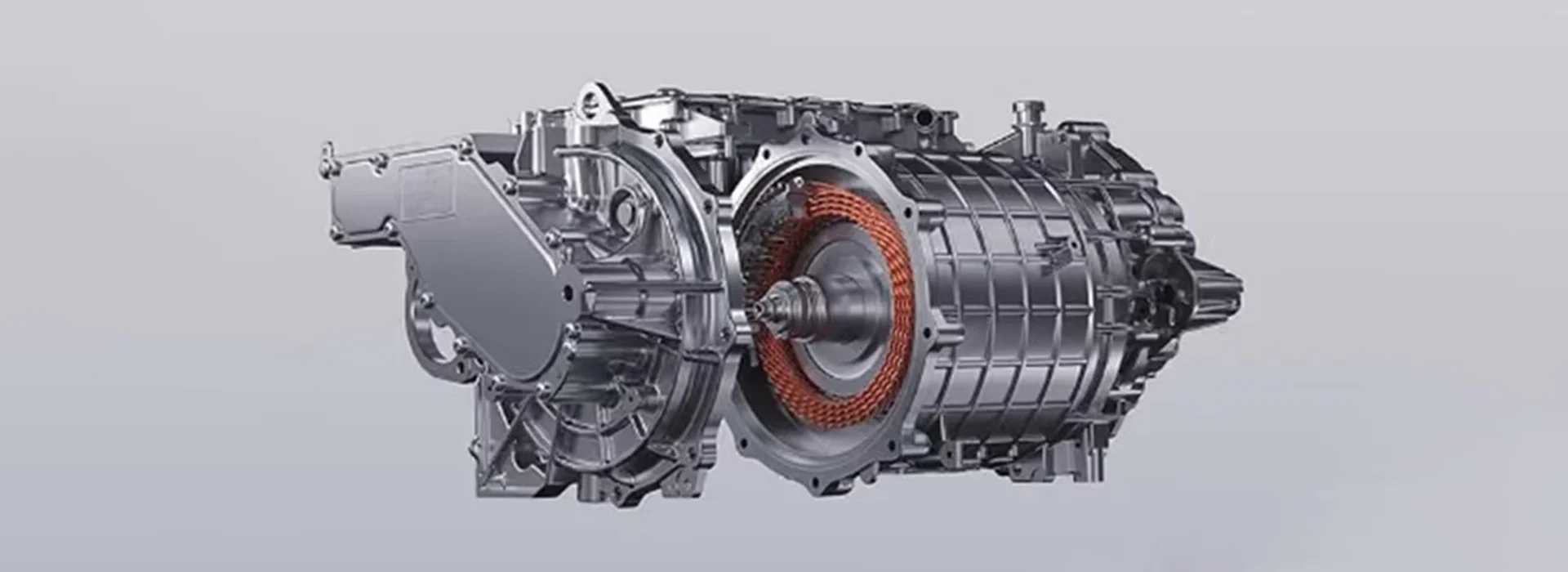
Applications · EV Traction Motors
Non-Oriented Steel for EV Traction MotorsHigh-strength, low-loss CRNGO for rotors and stators
Non-oriented silicon steel for EV and hybrid traction motor cores, 0.20–0.35 mm, engineered for the two things a spinning rotor demands: low core loss at high electrical frequency, and enough yield strength to survive centrifugal stress at motor speed. Standard and thin-gauge CRNGO grades, slit to your lamination width.
Product photos
CRNGO built for rotor and stator laminations
Coil through to stamped rotor and stator stacks, sized for the tight tolerances a spinning core demands.
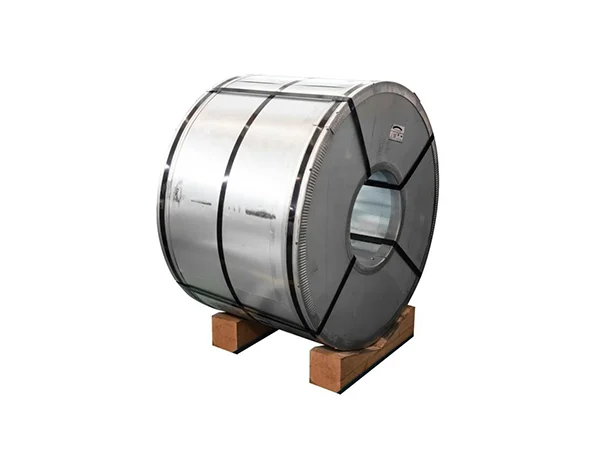 Master coil · 50W470–50W600
CRNGO Master Coil
Isotropic non-oriented coil, uniform properties in every direction for a rotating field.
- Thickness0.35–0.50 mm
- Core loss P1.5/50≤ 2.5 W/kg
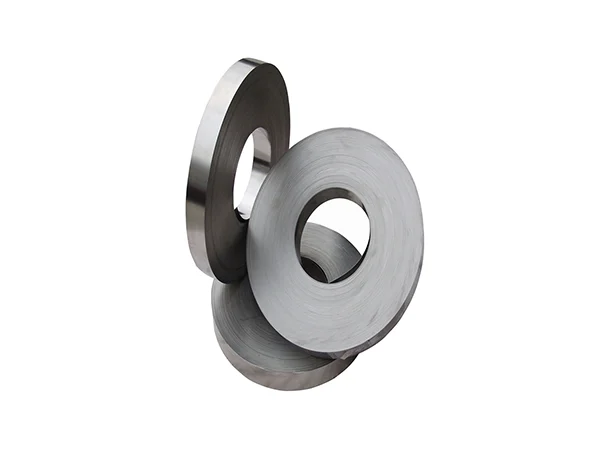 Thin-gauge slit strip · 0.20–0.27 mm
Thin-Gauge Slit Strip
Cut to your rotor/stator die width, in the thinner gauges high-speed traction motors need to control eddy-current loss.
- Thickness0.20–0.27 mm
- Core loss P1.0/400≤ 12–20 W/kg
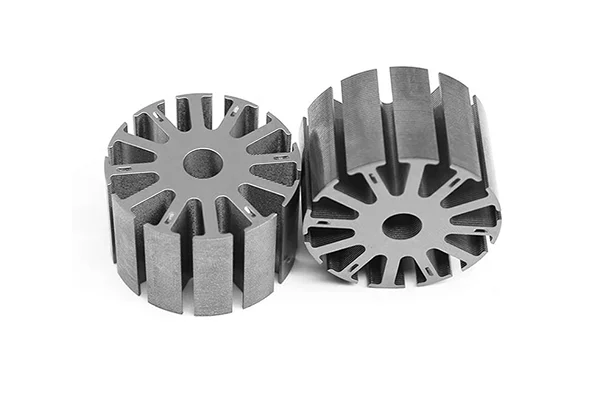 Stamped rotor & stator stack
Rotor & Stator Lamination Stack
Precision-stamped and stacked laminations, showing the low-burr edge quality that keeps interlocking tolerances tight at speed.
- Burr heightLow, controlled
- Stacking factorHigh
Why non-oriented
Three things a spinning rotor asks of its steel
An EV traction motor’s magnetic field rotates through a full 360° as the rotor turns, so — unlike a transformer core — it needs isotropic, non-oriented steel with the same low loss in every direction. From there, three engineering pressures shape the grade you actually pick: electrical frequency scales with rpm, so a motor spinning at 15,000–20,000 rpm sees a far higher operating frequency than one at 3,000 rpm, and eddy-current loss rises sharply with both frequency and thickness — pushing high-speed designs toward thinner gauge. At the same time, the rotor lamination itself has to survive real mechanical stress: centrifugal force at speed puts the rim under tension, so high-rpm rotors need steel with higher yield strength, not just lower loss. Balancing loss, strength and cost is the core selection problem for every EV motor programme.
Building a high-speed rotor above ~15,000 rpm or a compact e-axle unit? We also supply high-strength, thin-gauge CRNGO developed specifically for that combination of loss and mechanical strength — send us your target rpm and rotor OD and we’ll recommend a grade rather than guess from a catalogue page.
Motor types we supply for
Across the EV & hybrid drivetrain
Rotor and stator specs shift with motor type and duty — tell us which you’re building and we’ll recommend a grade.
01
Passenger EV traction motor
PMSM and induction motors for passenger vehicles, typically 8,000–20,000 rpm.
02
Commercial & heavy-duty EV motor
Higher-torque motors for trucks and buses, larger lamination diameters.
03
Hybrid (HEV/PHEV) motor
Compact motors sharing packaging space with a combustion drivetrain.
04
e-Axle / integrated drive unit
Motor, inverter and gearbox in one housing — tight rotor OD, high speed.
Application photos
Where this steel ends up
EV traction motors built with our CRNGO cores, from the stamping line to the drivetrain.
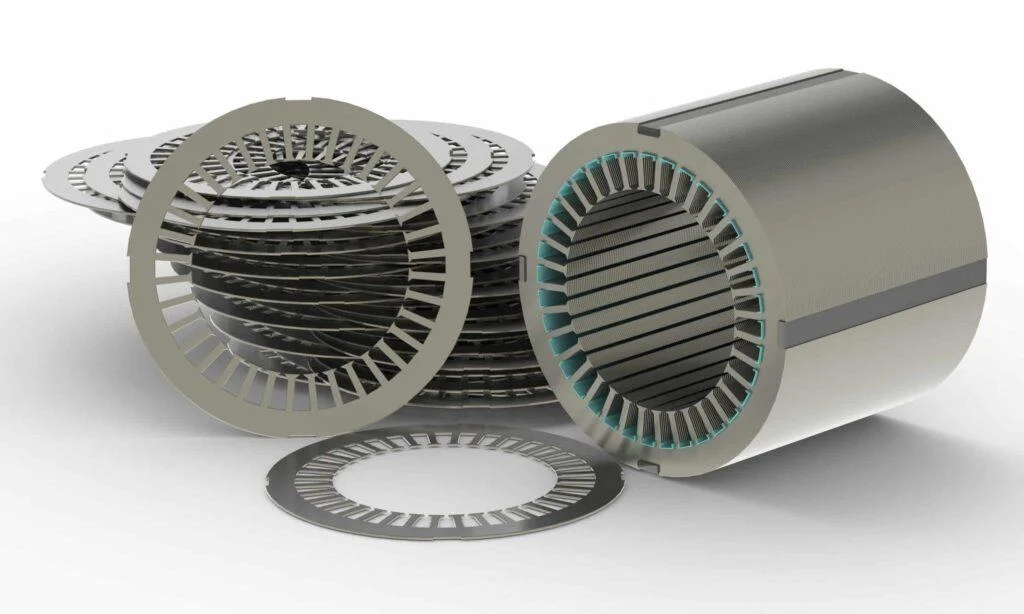 Rotor & stator core
Rotor & Stator Core
A built motor core, ready for winding and rotor balancing — the end point every coil we slit is heading toward.
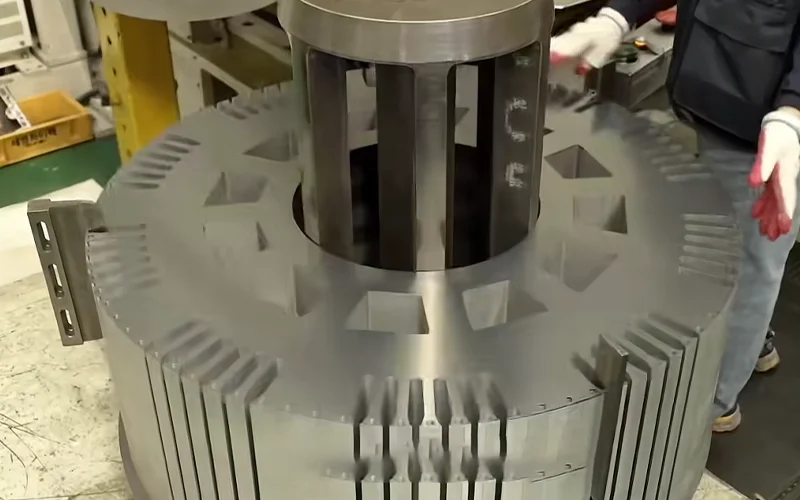 Stamping & stacking line
Stamping & Stacking Line
High-speed automated stamping — coil-to-coil thickness and flatness consistency keeps die wear and rejects low at this rate.
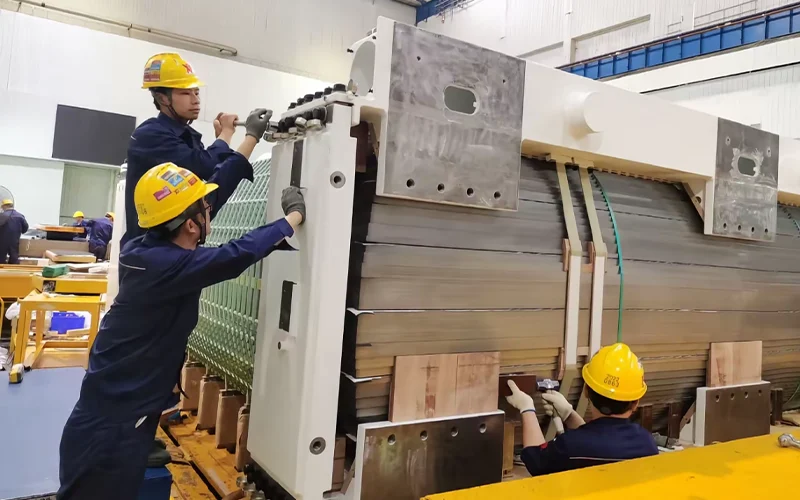 e-Axle drive unit
e-Axle Drive Unit
Motor, gearbox and inverter packaged together — where rotor OD and speed are most tightly constrained.
Side by side
Standard vs thin-gauge high-speed CRNGO
Standard CRNGO suits most hybrid and lower-speed traction motors; thin-gauge grades are for the higher rpm and tighter rotor OD of modern e-axle designs.
| Property | Standard CRNGO | Thin-gauge high-speed CRNGO |
|---|---|---|
| Thickness | 0.35–0.50 mm | 0.20–0.27 mm |
| Core loss reference | P1.5/50 ≤ 2.5 W/kg | P1.0/400 ≤ 12–20 W/kg |
| Typical rotor speed | Up to ~8,000 rpm | 15,000–20,000+ rpm |
| Mechanical demand | Standard yield strength | Elevated yield strength for centrifugal load |
| Best for | Hybrid & lower-speed traction motors | High-speed PMSM, e-axle, compact rotors |
Need the transformer side of our range instead? See non-oriented silicon steel → or the grain-oriented CRGO range →
Recommended grades
Grades we ship for EV motor cores
50W470 and 50W600 cover most standard-speed rotors and stators; for high-speed, thin-gauge and high-strength requirements, send us your rpm and rotor OD and we’ll match a grade rather than guess from a catalogue.
Equivalents, at a glance
How we work
From core spec to your dock
A simple path from spec to delivery, built for motor manufacturers and Tier 1 suppliers.
Send your spec
Grade, thickness, target rpm and rotor OD, or a lamination drawing.
Quote in 24h
Pricing and availability within one business day.
Free samples
Test core loss and stampability, usually within a week.
Production & QC
Rolled, slit and tested to grade, with a mill certificate.
Export delivery
Moisture-proof packing and ocean freight to your port.
FAQ
Sourcing CRNGO for EV traction motors
Why non-oriented steel instead of grain-oriented for EV motors?
A traction motor’s magnetic field rotates through a full 360° as the rotor spins, so it needs steel with uniform (isotropic) properties in every direction. Grain-oriented steel is optimised for one fixed flux axis, which fits a transformer core, not a rotating motor.
Why does gauge matter so much for high-speed EV motors?
Electrical frequency scales with rotor speed, and eddy-current loss rises sharply with both frequency and lamination thickness. A motor spinning at 15,000–20,000 rpm needs a thinner gauge than one at 3,000 rpm to keep core loss under control.
Do EV rotors really need higher-strength steel?
Yes — at high rpm, centrifugal force puts real mechanical stress on the rotor lamination rim. Thin-gauge, high-strength CRNGO grades are formulated to hold up under that load without sacrificing core loss performance.
What frequency do you test core loss at?
Standard-speed grades are typically referenced at 50/60 Hz; thin-gauge, high-speed grades are tested at higher frequencies (400 Hz and above) that better represent actual traction-motor operating conditions. Tell us your operating frequency and we’ll quote loss at that point.
Do rotor and stator laminations need different specs?
Often yes — the rotor usually carries the higher mechanical load, so it may call for a higher-strength grade, while the stator can sometimes use a lower-cost standard grade. Send your design and we can recommend per-part.
What’s the minimum order quantity for EV motor grades?
MOQ depends on grade, thickness and width. Tell us your target volume and we’ll confirm what’s workable — trial quantities are possible for new motor programmes.
Do you provide samples for motor prototyping?
Yes — free samples are usually ready within about a week, so you can test stampability and core loss before committing to a production order.
How fast can you quote and ship for a new motor programme?
Quotes come within 24 hours. Standard grades often ship from stock in days; thin-gauge and high-strength runs typically take a few weeks.
Do you provide mill test certificates?
Yes — a mill test certificate covering core loss, induction and mechanical properties ships with every order, under ISO 9001 and IATF 16949.
How do you handle export for automotive supply chains?
Seaworthy, moisture-proof packaging on coils or slit strip, shipped to any port, with documentation suited to Tier 1 automotive procurement. We’ll align on payment terms at the order stage.
Why buyers choose Zhongxin
Mill-grade material, export-ready service
Wuxi Zhongxin Special Steel Co., Ltd. is a Chinese manufacturer and exporter of grain-oriented, non-oriented and ultra-thin silicon steel, serving transformer and motor makers across Europe, the Americas, Asia and beyond.
Send your core spec — get a quote in 24 hours
Share grade, thickness, target rpm and rotor OD, or upload a drawing. Free samples available.